

How do you turn a blank sound into an actual melody? Choosing your first keyboard can feel like staring at an unlit fuse.
Finding the Best Synthesizers for Beginners requires more than just picking a cool shape. You need tools that invite you to experiment rather than confusing you with a wall of technical jargon. Let's see which options actually help you grow as a musician.
Key Takeaways
- Prioritize keyboards with velocity-sensitive keys to allow for expressive control over your volume and dynamics.
- Choose a model that includes built-in sounds if you want to play immediately without relying on a computer.
- Confirm your chosen device offers DAW compatibility if you eventually want to record your compositions into your computer software.
- Look for hands-on controls like knobs and sliders because these make learning sound design much more intuitive than menu-diving.
- Consider whether you prefer a compact portable unit for travel or a larger keybed that feels closer to a standard piano.
| Ultimate Educational Foundation |  |
Essential Synth Techniques Instruction Guide | Clear theoretical explanations | Easy to follow steps | Builds essential knowledge | View on Amazon | Read Review |
| Portable All-In-One |  |
Akai MPK Mini Play MK3 | Built-in sound library | Compact and portable | Responsive drum pads | View on Amazon | Read Review |
| Versatile Sound Engine |  |
Arturia MiniFreak Hybrid Polyphonic Synthesizer | Powerful hybrid synthesis | High voice count | Intuitive interface | View on Amazon | Read Review |
| Experimental Sonic Toy |  |
Korg Monotron Delay Synthesizer | Highly affordable | Unique ribbon interface | Deep delay effects | View on Amazon | Read Review |
| Compact Vector Power |  |
Behringer Pro VS Mini Synthesizer | Unique morphing oscillators | Solid analog filter | Built-in pattern sequencer | View on Amazon | Read Review |
| Iconic Retro Fun |  |
Stylophone Original Pocket Synthesizer | Extremely easy to use | Cult classic status | Very lightweight | View on Amazon | Read Review |
| Creative Modulation Hub | 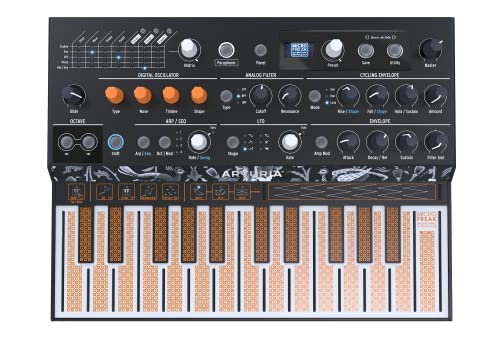 |
Arturia MicroFreak Paraphonic Synthesizer | Incredible sonic variety | Expressive touch keyboard | Compact and rugged | View on Amazon | Read Review |
| Slim Desktop Essential |  |
Akai LPK25 MIDI Controller | Ultra-slim footprint | Simple plug-and-play | Affordable entry point | View on Amazon | Read Review |
| Budget Feature Packed |  |
M-VAVE 25 Key MIDI Controller | Includes drum pads | Wireless MIDI capability | Assignable control knobs | View on Amazon | Read Review |
| Professional Analog Tone |  |
Moog Messenger Monophonic Analog Synthesizer | Classic analog sound | Deep step sequencer | Extensive preset library | View on Amazon | Read Review |
More Details on Our Top Picks
-
Essential Synth Techniques Instruction Guide
If you are staring at a synthesizer and feel like you are looking at the cockpit of a jet, this guide is your flight manual. It provides the fundamental building blocks you need to understand how sound is actually created.
You will find it helpful for demystifying complex concepts like oscillators and envelopes. However, it is a print or digital resource rather than an instrument, so you will need a synth to practice on while you read.
- Brand:Various
- Type:Instructional Guide
- Additional Feature:Explains signal flow clearly
- Additional Feature:Covers basic sound design
- Additional Feature:Defines essential synth terminology
-
Akai MPK Mini Play MK3
This is a stand-alone instrument that does not require a computer to produce sound. It is perfect for someone who wants to sketch out ideas on the bus or at a park bench.
The built-in speaker and eight drum pads make it a fantastic tool for quick beat creation. Keep in mind that the keys are quite small, so it might feel cramped if you have larger hands.
- Brand:Akai Professional
- Type:MIDI Keyboard
- Key Count:25 keys
- Connectivity:USB and MIDI
- Power Source:Batteries or USB
- Included Software:MPC Beats
- Additional Feature:Integrated miniature speaker
- Additional Feature:Velocity sensitive mini keys
- Additional Feature:Eight assignable control knobs
-
Arturia MiniFreak Hybrid Polyphonic Synthesizer
The MiniFreak is like a Swiss Army knife for your studio. It combines digital oscillators with analog filters to offer a massive range of sonic possibilities.
The six-voice polyphony allows you to play complex chords without notes cutting off prematurely. It is a powerful machine, so the sheer number of menu options can feel overwhelming to a complete beginner.
- Brand:Arturia
- Type:Hybrid Synthesizer
- Key Count:37 keys
- Connectivity:USB, MIDI, CV
- Power Source:External power supply
- Additional Feature:Multi-mode digital oscillators
- Additional Feature:Analog filter section
- Additional Feature:Built-in modulation matrix
-
Korg Monotron Delay Synthesizer
If you want to create wild, space-age sound effects, this is your best friend. It uses a ribbon controller rather than a traditional keyboard, which encourages you to slide between notes and explore strange textures.
The space delay effect is surprisingly deep and fun to manipulate in real time. Because it is so small, you lack the precision of full-sized keys, making it more of an effect unit than a melodic instrument.
- Brand:Korg
- Type:Analog Synthesizer
- Power Source:Two AAA batteries
- Additional Feature:Analog signal path
- Additional Feature:Portable palm-sized design
- Additional Feature:Internal speaker included
-
Behringer Pro VS Mini Synthesizer
This tiny powerhouse brings vector morphing synthesis into a portable frame. It is a great choice if you want to experiment with shifting, evolving sounds that move and breathe.
The 16-step sequencer makes it easy to build patterns quickly. While it is quite capable, the interface relies on a small screen that can be tricky to navigate if you have poor eyesight.
- Brand:Behringer
- Type:Hybrid Synthesizer
- Connectivity:USB and MIDI
- Power Source:USB powered
- Additional Feature:Four vector oscillators
- Additional Feature:Arpeggiator functionality
- Additional Feature:Portable desktop form factor
-
Stylophone Original Pocket Synthesizer
The Stylophone is a classic piece of musical history that is still incredibly fun today. You use a stylus to touch the metal keyboard, creating a distinct, buzzy tone that is instantly recognizable.
It is simple enough that anyone can play a melody within minutes of opening the box. Do not expect studio-grade fidelity, as it is designed for quirky, nostalgic sounds.
- Brand:Stylophone
- Type:Analog Synthesizer
- Power Source:Battery powered
- Additional Feature:Built-in speaker
- Additional Feature:Vibrato effect switch
- Additional Feature:Stylus control interface
-
Arturia MicroFreak Paraphonic Synthesizer
This is arguably the most adventurous instrument on this list. It offers 21 oscillator modes, ranging from physical modeling to wavetable synthesis, which means you will never run out of things to discover.
The poly-aftertouch keyboard is a rare and welcome feature that lets you add expression by varying how hard you press the keys. It lacks a traditional keybed feel, so it takes some time to get used to the flat surface.
- Brand:Arturia
- Type:Paraphonic Synthesizer
- Key Count:25 keys
- Connectivity:USB, MIDI, CV
- Power Source:External power supply
- Additional Feature:Multi-engine oscillators
- Additional Feature:Pressure sensitive keys
- Additional Feature:CV and gate outputs
-
Akai LPK25 MIDI Controller
The LPK25 is a no-nonsense controller for your computer software. It provides the essential keys you need to input notes into your music production program without taking up your entire desk.
It is incredibly lightweight and slides easily into a laptop bag. Remember that it does not contain its own sounds, so you must connect it to a computer running software to hear anything.
- Brand:Akai Professional
- Type:MIDI Keyboard
- Key Count:25 keys
- Connectivity:USB
- Power Source:USB powered
- Additional Feature:Built-in arpeggiator
- Additional Feature:Velocity sensitive keys
- Additional Feature:Sustain pedal input
-
M-VAVE 25 Key MIDI Controller
If you want a controller that includes drum pads, knobs, and keys in one package, this covers all bases. It is designed for those who want to control their DAW and trigger loops simultaneously.
The Bluetooth connectivity is a nice touch if you prefer a wireless workspace. The build quality feels lighter compared to premium controllers, but it gets the job done for a home studio.
- Brand:M-VAVE
- Type:MIDI Keyboard
- Key Count:25 keys
- Connectivity:USB and Bluetooth
- Power Source:USB or internal battery
- Included Software:Production suite
- Additional Feature:Semi-weighted key feel
- Additional Feature:Backlit performance pads
- Additional Feature:Portable design
-
Moog Messenger Monophonic Analog Synthesizer
This instrument carries the legendary sound quality associated with its manufacturer. It is a monophonic synth, meaning it plays one note at a time, which makes it perfect for thick, punchy basslines and soaring leads.
The 64-step sequencer allows you to build complex, evolving sequences that sound like they belong on a record. It is a more specialized piece of gear, so it is best for those focused on learning classic synthesis.
- Brand:Moog
- Type:Analog Synthesizer
- Key Count:32 keys
- Connectivity:USB and MIDI
- Power Source:Power adapter
- Additional Feature:256 onboard presets
- Additional Feature:Bass compensation circuitry
- Additional Feature:Classic analog signal path
Frequently Asked Questions
Do I need to know music theory to play a synthesizer?
You do not need formal training to start making sounds. Many beginners focus on sound design rather than traditional melody at first. Learning the basics of scales and chords will help later, but you can create amazing textures just by experimenting with oscillators and filters.
What is the difference between a synth and a MIDI controller?
A synthesizer contains its own internal sound engine, meaning it creates audio by itself. A MIDI controller is just a keyboard that sends digital messages to software on your computer. It cannot make any sound unless it is plugged into a computer or another device.
Is it better to start with hardware or software?
Hardware offers a tactile experience that many find more inspiring. You learn faster when you can reach out and grab a physical knob to shape your tone. Software is cheaper and offers more features, but it lacks the physical connection to your instrument.
How much should I spend on my first synth?
You can find capable entry-level models between three hundred and six hundred dollars. This price range usually provides a good balance of quality components and useful features. Do not feel pressured to buy the most expensive gear, as simpler instruments often teach you the fundamentals more effectively.
Can I record my synthesizer directly into my phone?
You usually need an audio interface to get a clean signal into a phone or computer. Plugging a synth directly into a headphone jack often results in poor sound quality or high noise levels. Using a dedicated interface ensures your recordings sound professional and clear.