
The secret to picking the Best Synthesizers for Beginners lies in the balance between playability and technical depth. You want something that provides immediate sonic satisfaction without requiring a degree in electrical engineering to produce a simple melody.
Focusing on hardware that encourages intuitive exploration will keep you motivated far longer than a complex piece of equipment that hides its best features behind deep menu layers. Let us look at what makes these instruments worth your attention.
Key Takeaways
- Prioritize models that include a built-in speaker or battery power if you prefer the freedom to practice away from a desk.
- Look for a keyboard or interface size that matches your available workspace to avoid cluttering your studio.
- Check if the instrument offers MIDI capabilities, as this allows you to expand your reach by connecting to computer software later.
- Choose polyphonic instruments if you plan to play chords, whereas monophonic options are better suited for focused lead lines and bass.
- Consider how much hands-on control you need, as physical knobs and sliders offer a more direct way to shape your sound than digital screens.
| Entry Level Breath Control |  |
Vangoa EWI-100 Digital Wind Instrument | Lightweight portable design | Built-in speaker included | Rechargeable battery power | View on Amazon | Read Review |
| All-In-One Beat Maker |  |
Akai MPK Mini Play MK3 Keyboard | Built-in sound library | Portable integrated speaker | Responsive drum pads | View on Amazon | Read Review |
| Deep Sound Design |  |
Arturia MiniFreak Hybrid Synthesizer | Powerful hybrid engine | Intuitive modulation matrix | Great polyphonic capabilities | View on Amazon | Read Review |
| Compact FM Powerhouse |  |
Korg Volca FM2 Digital Synthesizer | Authentic FM synthesis | Integrated 16-step sequencer | Highly portable footprint | View on Amazon | Read Review |
| Experimental Sound Toy |  |
Korg Monotron Delay Analog Synthesizer | True analog circuitry | Fun ribbon controller | Intense delay effects | View on Amazon | Read Review |
| Retro Fun Machine |  |
Stylophone Original Pocket Synthesizer | Iconic retro sound | Easy stylus interface | Very affordable entry point | View on Amazon | Read Review |
| Advanced Sequence Control |  |
Akai MPK Mini Plus Controller | Includes hardware sequencer | Expanded key range | Solid build quality | View on Amazon | Read Review |
| Creative Texture Explorer | 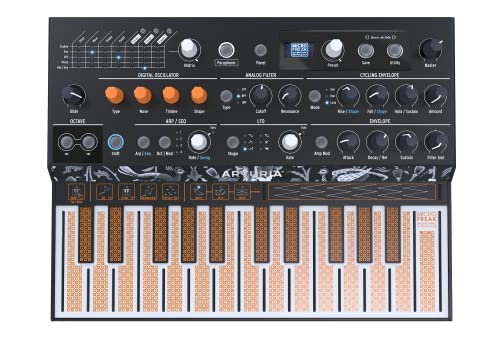 |
Arturia MicroFreak Paraphonic Synthesizer | Versatile oscillator modes | Unique touch keybed | Innovative modulation options | View on Amazon | Read Review |
| Streamlined Note Entry |  |
Akai LPK25 USB MIDI Controller | Extremely compact design | Simple plug-and-play setup | Reliable key action | View on Amazon | Read Review |
| Vocoder Vocal Specialist |  |
Novation MiniNova Analog Modeling Synthesizer | Excellent built-in vocoder | Wide range of presets | Powerful performance buttons | View on Amazon | Read Review |
More Details on Our Top Picks
-
Vangoa EWI-100 Digital Wind Instrument
If you want to move beyond standard piano-style keys, this electronic wind instrument offers a unique playing experience. It mimics the feel of a woodwind, making it a great pick for musicians who prefer breath-based expression over percussive input.
The interface is approachable for beginners who feel intimidated by complex menus. However, keep in mind that the plastic build feels a bit light, so you should handle it with care during your practice sessions.
- Instrument Type:Electronic wind synthesizer
- Power Source:Rechargeable battery
- Connection Type:Wireless and USB
- Additional Feature:Multiple sensitivity settings
- Additional Feature:Integrated speaker system
- Additional Feature:Detachable mouthpiece for cleaning
-
Akai MPK Mini Play MK3 Keyboard
This is the Swiss Army knife for producers who need a portable studio on the go. By combining velocity-sensitive keys with built-in sounds and a speaker, it lets you compose music without connecting to a computer.
The drum pads offer a satisfying tactile response for finger drumming. Just remember that the keys are small, which might feel cramped if you are accustomed to a full-sized piano.
- Instrument Type:MIDI keyboard controller
- Key Count:25 keys
- Power Source:USB or batteries
- Connection Type:USB MIDI
- Polyphony Voice:128 voices
- Additional Feature:Assignable control knobs
- Additional Feature:Built-in sustain pedal input
- Additional Feature:OLED display for feedback
-
Arturia MiniFreak Hybrid Synthesizer
For those who want to learn how synthesis actually works, this hybrid engine is a masterclass in versatility. It blends digital oscillators with analog filters, giving you a massive range of textures that sound professional right out of the box.
The modulation matrix is intuitive, allowing you to route signals with ease. It is a powerful tool, but the depth of features might require some dedicated study time for a complete novice.
- Instrument Type:Hybrid synthesizer
- Key Count:37 keys
- Polyphony Voice:6 voices
- Additional Feature:Built-in digital effects
- Additional Feature:Arpeggiator and sequencer
- Additional Feature:OLED screen display
-
Korg Volca FM2 Digital Synthesizer
If you love the classic sounds of 80s hardware, this tiny box brings FM synthesis into the modern era. It is remarkably small, yet it contains an advanced sequencer that makes creating complex patterns quite simple.
You get six voices of polyphony, which is impressive for such a small frame. Just note that the tiny knobs can be difficult to adjust precisely if you have larger hands.
- Instrument Type:Digital synthesizer
- Connection Type:MIDI and Sync
- Polyphony Voice:6 voices
- Additional Feature:Chorus and reverb effects
- Additional Feature:Warp active step function
- Additional Feature:Battery powered operation
-
Korg Monotron Delay Analog Synthesizer
This is essentially a pocket-sized laboratory for analog noise and wild soundscapes. It uses a ribbon controller instead of keys, which encourages you to slide between notes and explore unconventional melodies.
The delay effect creates long, sweeping feedback loops that are incredibly fun to manipulate. It is a simple tool, so do not expect to save presets or build entire songs from scratch.
- Instrument Type:Analog synthesizer
- Power Source:Battery
- Connection Type:Headphone output
- Additional Feature:Built-in speaker
- Additional Feature:Auxiliary input for processing
- Additional Feature:Battery powered portability
-
Stylophone Original Pocket Synthesizer
This classic instrument is a nostalgic piece of history that remains a blast to play. You use a metal stylus to tap the touch-sensitive keyboard, which produces a quirky, lo-fi buzzing sound that defined a generation of pop music.
It is incredibly simple, making it perfect for beginners who just want to make noise. You will not find advanced sequencing or MIDI connectivity here, but that is part of the charming simplicity.
- Instrument Type:Analog synthesizer
- Power Source:Batteries
- Connection Type:Headphone out
- Additional Feature:Built-in speaker
- Additional Feature:Vibrato control switch
- Additional Feature:Portable pocket size
-
Akai MPK Mini Plus Controller
When you need more than just keys, this controller provides a dedicated sequencer and extensive connectivity options. It allows you to control modular gear or hardware synths, acting as the central brain of your setup.
The addition of extra keys makes two-handed playing much more viable than on smaller models. It is feature-rich, so you should be prepared to spend a little time mapping the controls to your software.
- Instrument Type:MIDI keyboard controller
- Key Count:37 keys
- Connection Type:USB and MIDI
- Additional Feature:CV and Gate outputs
- Additional Feature:Built-in arpeggiator
- Additional Feature:Transport control buttons
-
Arturia MicroFreak Paraphonic Synthesizer
This instrument pushes the boundaries of what a beginner synth can do by including diverse oscillator modes. You can switch from wavetable synthesis to physical modeling in seconds, providing an endless well of inspiration.
The touch-sensitive keyboard is a unique touch that supports polyphonic aftertouch. It is a brilliant design, but the flat keybed takes some time to get used to if you prefer traditional piano keys.
- Instrument Type:Digital hybrid synthesizer
- Key Count:25 keys
- Polyphony Voice:Paraphonic
- Additional Feature:Modulation matrix routing
- Additional Feature:Built-in arpeggiator
- Additional Feature:CV and Gate ports
-
Akai LPK25 USB MIDI Controller
Sometimes you just want a simple keyboard to input notes into your computer. This unit is compact, rugged, and does exactly what it promises without any unnecessary fluff or steep learning curves.
It is the perfect companion for a laptop-based studio where space is at a premium. Because it lacks onboard sounds, you must have a computer or tablet to actually hear any music.
- Instrument Type:MIDI controller
- Key Count:25 keys
- Power Source:USB
- Connection Type:USB
- Additional Feature:Built-in arpeggiator
- Additional Feature:Sustain pedal input
- Additional Feature:Octave range buttons
-
Novation MiniNova Analog Modeling Synthesizer
If you want to manipulate your voice as much as your melodies, this is a top-tier choice. It features a dedicated vocoder and a wide range of effects, allowing you to create robotic or dreamy vocal textures with minimal effort.
The animate buttons provide great performance control for live shows. The menus can get a bit deep, so you might want to keep the manual nearby while you learn the ropes.
- Instrument Type:Analog modeling synthesizer
- Key Count:37 keys
- Preset Count:256
- Polyphony Voice:18 voices
- Additional Feature:Performance animate buttons
- Additional Feature:Built-in effects engine
- Additional Feature:Included gooseneck microphone
Frequently Asked Questions
Do I need a computer to use a synthesizer?
It depends on the model you buy. Many modern synthesizers have built-in speakers or a headphone jack, so you can play them standalone right out of the box. However, some devices are strictly MIDI controllers that only produce sound when plugged into a computer. Check the product description carefully to see if it makes noise on its own.
What is a patch?
A patch is a saved sound setting on your synthesizer. Think of it like a recipe for a specific tone, such as a bass, a string ensemble, or a drum beat. Most synths come with hundreds of factory presets that you can use immediately. You can also tweak these patches and save your own custom versions.
Is it hard to learn how to play a synthesizer?
Learning the basics of sound design is quite approachable if you start with a simple interface. You will pick up the functions of oscillators, filters, and envelopes quickly through regular practice. If you already know how to play piano, you have a massive head start. If not, you can learn the fundamentals of music theory alongside your knob-turning experiments.
Should I buy a monophonic or polyphonic synth?
A monophonic synth is perfect if you are focused on bass lines or lead melodies. It forces you to think about one note at a time, which is a great creative constraint. If you want to play chords or backing tracks, you absolutely need a polyphonic model. Most beginners prefer polyphonic synths because they offer more flexibility for different musical styles.
Can I record my synthesizer into my phone?
Yes, but you will likely need an audio interface or a specific adapter cable. These devices convert the analog signal from your synth into a digital format that your phone can understand. Look for a class-compliant interface to ensure it works with your mobile operating system. This is a very common way for modern musicians to capture quick ideas on the move.