
The studio is quiet, but your mind is buzzing with a melody that needs to escape. You stare at a blank DAW screen or a pile of cables, wishing for a sound that feels tangible and immediate.
Selecting the Best Synths for Beginners can feel like choosing a path through a dense, foggy forest. A clear starting point makes all the difference when you are just beginning to build your sonic signature. Keep reading to find the tool that fits your creative rhythm.
Key Takeaways
- Prioritize units that include a built-in speaker if you want to perform anywhere without needing extra equipment.
- Check if the instrument features a MIDI connection, as this allows you to control software or other hardware as you grow.
- Look for tactile interfaces like knobs and pads because physical control makes learning sound design much more intuitive.
- Consider whether you need a monophonic synth for lead lines or a polyphonic one to play complex chords.
- Verify the power requirements to ensure you have the right cables or batteries for your setup.
| Breath Controlled Exploration |  |
Vangoa EWI-100 Digital Wind Instrument | Intuitive breath control | Extremely portable design | Rechargeable internal battery | View on Amazon | Read Review |
| Classic Nostalgic Fun |  |
Stylophone Original Pocket Synthesizer | Simple stylus interface | Distinctive vintage sound | Highly compact size | View on Amazon | Read Review |
| Experimental Creative Tool |  |
Synth-a-Sette Cassette Sized Synthesizer | Unique conductive input | Highly portable form | DIY friendly design | View on Amazon | Read Review |
| Iconic Acid Sound |  |
Behringer TD-3 Analog Bass Synth | Authentic analog circuitry | Built-in distortion effect | Versatile pattern sequencer | View on Amazon | Read Review |
| Polysynth Powerhouse |  |
Roland AIRA Compact S-1 Synth | Powerful polyphonic engine | Portable motion control | Deep sound sculpting | View on Amazon | Read Review |
| Standalone Beat Maker |  |
Akai MPK Mini Play MK3 | Built-in sound library | Integrated speaker | Portable size | View on Amazon | Read Review |
| Instant Melody Maker |  |
Stylophone Stylosette Pocket Synthesizer | Responsive touch keyboard | Portable cassette size | Integrated sound output | View on Amazon | Read Review |
| Studio Production Essential |  |
Akai MPK Mini MK3 Controller | Excellent software integration | Responsive MPC pads | Sturdy build quality | View on Amazon | Read Review |
| Authentic Analog Soul |  |
Moog Messenger Monophonic Analog Synth | Classic analog sound | Extensive preset storage | Versatile 64-step sequencer | View on Amazon | Read Review |
| Versatile Sound Laboratory | 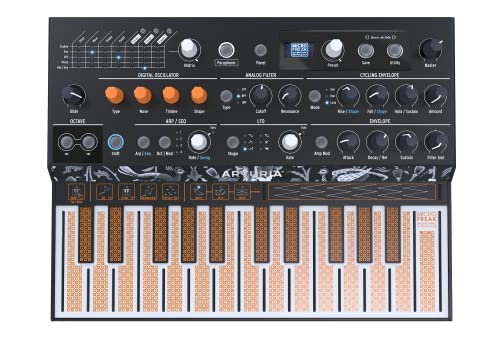 |
Arturia MicroFreak Paraphonic Synth | Poly-aftertouch keyboard | Massive variety of sounds | Unique digital oscillators | View on Amazon | Read Review |
More Details on Our Top Picks
-
Vangoa EWI-100 Digital Wind Instrument
If you want to move beyond traditional keys, this wind synthesizer offers a unique way to shape sound. It is ideal for beginners who prefer using their breath to modulate volume and expression rather than just striking a key.
You will find it handles like a recorder, making the learning curve quite manageable for most newcomers. Keep in mind that the plastic build feels a bit lightweight, so treat it with the care you would afford any portable electronic device.
- Brand:Vangoa
- Instrument Type:Electronic Wind Instrument
- Power Source:Rechargeable battery
- Interface Type:Mouthpiece controller
- Additional Feature:Removable mouthpiece
- Additional Feature:Multiple built-in tones
- Additional Feature:Lightweight construction
-
Stylophone Original Pocket Synthesizer
This piece of gear is a cultural icon that remains popular for its quirky, lo-fi sound palette. It is a fantastic choice if you want to understand the basics of analog synthesis without getting bogged down in complex menus or deep signal chains.
You play it by touching a metal stylus to a conductive keyboard, which produces a distinctive, buzzing tone. Because it is monophonic, you can only play one note at a time, so you should expect a simple, stripped-back musical experience.
- Brand:Stylophone
- Instrument Type:Analog Synthesizer
- Power Source:Battery
- Interface Type:Metal stylus
- Control Features:Tuning knob
- Additional Feature:Built-in speaker
- Additional Feature:Vibrato switch
- Additional Feature:Battery operated
-
Synth-a-Sette Cassette Sized Synthesizer
This compact device is built for the adventurous beginner who likes to tinker with unconventional inputs. It doubles as a portable synth and a way to create a banana keyboard, using conductivity to trigger sounds through everyday objects.
It is surprisingly capable for its size, allowing you to build melodies on the go. Since it relies on conductive surfaces, it is best suited for people who enjoy DIY electronics and don't mind a bit of experimentation to get the best results.
- Brand:Synth-a-Sette
- Instrument Type:Analog Synthesizer
- Power Source:Battery
- Interface Type:Conductive touch points
- Additional Feature:Cassette size housing
- Additional Feature:External trigger inputs
- Additional Feature:Portable sound engine
-
Behringer TD-3 Analog Bass Synth
If you dream of creating classic dance music, this is the gold standard for an affordable, authentic bass line experience. It features a 16-step sequencer that makes it easy to program rhythmic patterns that loop and evolve over time.
The signal path is fully analog, which gives your tracks that gritty, squelching character found in vintage hardware. Be aware that the programming workflow requires some patience, as you will need to learn how to input steps manually.
- Brand:Behringer
- Instrument Type:Analog Bass Synthesizer
- Power Source:Power adapter
- Interface Type:Analog knobs and buttons
- Control Features:16-step sequencer
- Additional Feature:Poly chain capability
- Additional Feature:Resonant filter control
- Additional Feature:Distortion circuit
-
Roland AIRA Compact S-1 Synth
This tiny unit packs a surprising amount of advanced synthesis into a footprint no larger than a smartphone. It is perfect for those who want to learn subtractive synthesis while having the ability to play chords, thanks to its polyphonic engine.
The motion control feature allows you to tilt the device to change your sound, which adds a layer of performance flair. The internal menus are deep, so you might spend a little time memorizing the button combinations to access specific features.
- Brand:Roland
- Instrument Type:Digital Polysynth
- Power Source:Rechargeable battery
- Interface Type:Step-sequencer buttons
- Control Features:D-Motion control
- Additional Feature:Built-in arpeggiator
- Additional Feature:Step sequencer
- Additional Feature:Compact battery operation
-
Akai MPK Mini Play MK3
You get the best of both worlds here: a MIDI controller that also functions as a standalone instrument with its own speaker. This is an excellent pick if you want to practice your finger drumming on the 8 MPC pads without needing to plug into a computer.
It serves as a perfect entry point for someone interested in modern music production. While the keys are small, they are velocity-sensitive, which helps you add expression to your performances.
- Brand:Akai Professional
- Instrument Type:MIDI Keyboard Controller
- Key Count:25 keys
- Power Source:USB or battery
- Interface Type:Velocity-sensitive keys
- Control Features:8 knobs and pads
- Additional Feature:Internal speaker
- Additional Feature:Built-in sounds
- Additional Feature:Included software suite
-
Stylophone Stylosette Pocket Synthesizer
This model brings a more modern, accessible approach to the classic touch keyboard concept. It is designed for those who want to hear results immediately, as the layout allows you to play simple tunes with a single touch.
The inclusion of an expansion port means you can grow your setup as you gain confidence. Because the keys are integrated into the casing, it is incredibly durable for carrying in a backpack or gig bag.
- Brand:Stylophone
- Instrument Type:Portable Synthesizer
- Power Source:Battery
- Interface Type:Touch keyboard
- Control Features:FX controls
- Additional Feature:Built-in speaker
- Additional Feature:Expansion port
- Additional Feature:Portable design
-
Akai MPK Mini MK3 Controller
If your goal is to record music into a computer, this is the industry standard for a compact controller. It provides a clean, reliable way to input notes into your DAW software while offering plenty of tactile knobs to control your virtual instruments.
There are no built-in sounds, so you must connect this to a computer or mobile device to hear anything. It is an investment in your future workflow rather than just a standalone toy.
- Brand:Akai Professional
- Instrument Type:MIDI Keyboard Controller
- Key Count:25 keys
- Power Source:USB
- Interface Type:Velocity-sensitive keys
- Control Features:8 knobs and pads
- Additional Feature:Octave selection buttons
- Additional Feature:Arpeggiator
- Additional Feature:Included software suite
-
Moog Messenger Monophonic Analog Synth
Choosing this synth gives you access to the legendary tone and build quality that this brand is known for. It is a monophonic machine, meaning it excels at soaring leads and deep bass, making it perfect for someone who wants to focus on one voice at a time.
With a 64-step sequencer and internal storage for hundreds of presets, you can save your creations and build complex arrangements. You will need to commit to learning the signal flow, but the sound quality is well worth the study time.
- Brand:Moog
- Instrument Type:Monophonic Analog Synth
- Key Count:32 keys
- Power Source:Power adapter
- Control Features:64-step sequencer
- Additional Feature:Presets included
- Additional Feature:Res bass compensation
- Additional Feature:Analog signal path
-
Arturia MicroFreak Paraphonic Synth
This is arguably the most creative synth for a beginner who wants to explore various synthesis methods in one place. Its poly-aftertouch keyboard lets you change the sound by applying different levels of pressure, which is a rare feature at this level.
It offers dozens of oscillator modes, ranging from digital modeling to wavetable synthesis, ensuring you will not run out of new sounds to learn. The learning curve is moderate, but the wide range of sonic possibilities makes it a long-term keeper.
- Brand:Arturia
- Instrument Type:Paraphonic Synthesizer
- Key Count:25 keys
- Interface Type:Touch-capacitive keyboard
- Control Features:CV pitch and gate
- Additional Feature:21 oscillator modes
- Additional Feature:Mod matrix routing
- Additional Feature:Arpeggiator and sequencer
Frequently Asked Questions
Do I need to learn piano to play a synthesizer?
You do not need formal piano training to get started. While basic knowledge of music theory helps, synths are often used to create textures and rhythmic sequences that do not require traditional technique. You can focus on sound design and experimenting with knobs until your musical ear develops.
What is a patch or preset?
A patch is a saved collection of settings that creates a specific sound. These built-in presets allow you to start playing immediately without having to build a sound from scratch. As you grow, you will learn to tweak these patches to create your own signature tones.
Can I use a synth without external speakers?
Most synths feature a headphone jack, allowing you to practice silently at any hour. If you want to play out loud, you will need a pair of powered monitors or a dedicated keyboard amplifier. Do not plug a synth into standard computer speakers, as the audio signal might damage them.
What is an oscillator?
The oscillator is the heart of your synth, acting as the sound source that produces the initial waveform. It is like the raw clay that you later sculpt using filters and envelopes. Most beginner synths offer multiple waveform shapes like sine, square, or sawtooth waves.
How much should I spend on my first synth?
You can find high-quality entry-level gear between $300 and $600. Spending in this range usually gets you a reliable build and enough features to keep you busy for several years. Avoid the absolute cheapest options, as they often lack the hands-on controls necessary for learning how sound works.